Pompeii
As I write this, the next part of this story, I realize the profound shortness of life. People sometimes ask, why so interested in the ancient world?
Well, here in Pompeii, or anywhere else in the past, there is a big world. Time to breathe, think and be alive, for much, much longer.
So, come with me.
We’re going to meet a very special woman today.
Someone I’ve contemplated in my time, so to speak. Even before Mary and I first met. Perhaps, in the telling, the reasons may be revealed.
We’re visiting a market and trading town on the Bay of Naples. About the same size as my town by the river.
In his Geographia, the Greek writer Strabo says that Pompeii is a place of trade on the River Sarno, a shipping port serving Nola, Nuceria and Acerrae.
Cargoes from the Roman world and beyond travel inland, mostly upriver as they do from Ostia to Rome. And then new cargoes come from the nearby countryside and towns, to be shipped out to sea.
To others, waiting.
Strabo writes that above the town stands Vesuvius. Its lower slopes cultivated and beautiful, the summit barren, ash-coloured and scarred by rock that seems to have been burned. Strabo reasons that the mountain must once have contained fire and then become quiet.
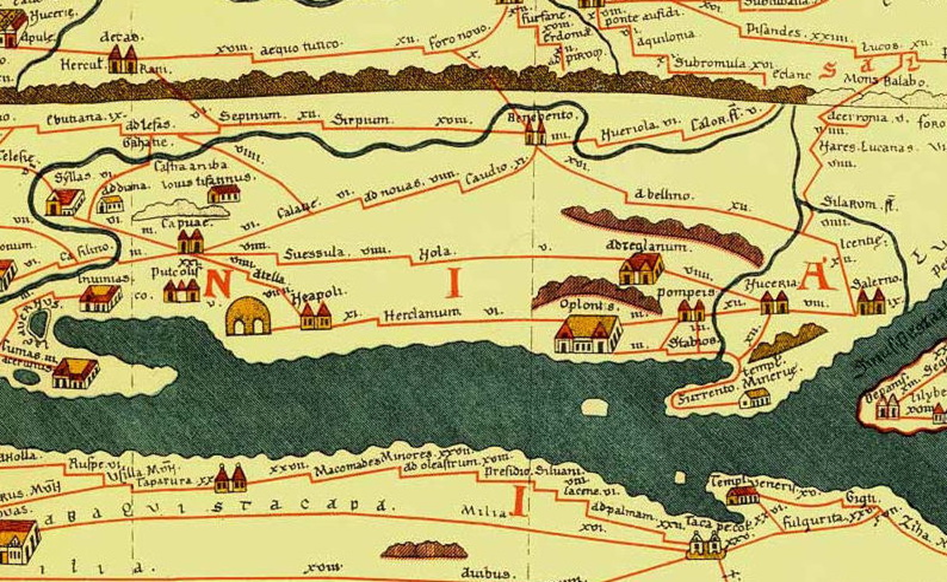
The Bay of Naples on the Tabula Peutingeriana. Pompeii appears near Oplontis and Herculaneum.
Mary stands outside the Herculaneum Gate, the Villa of the Mysteries behind her, as she points up at the mountain.
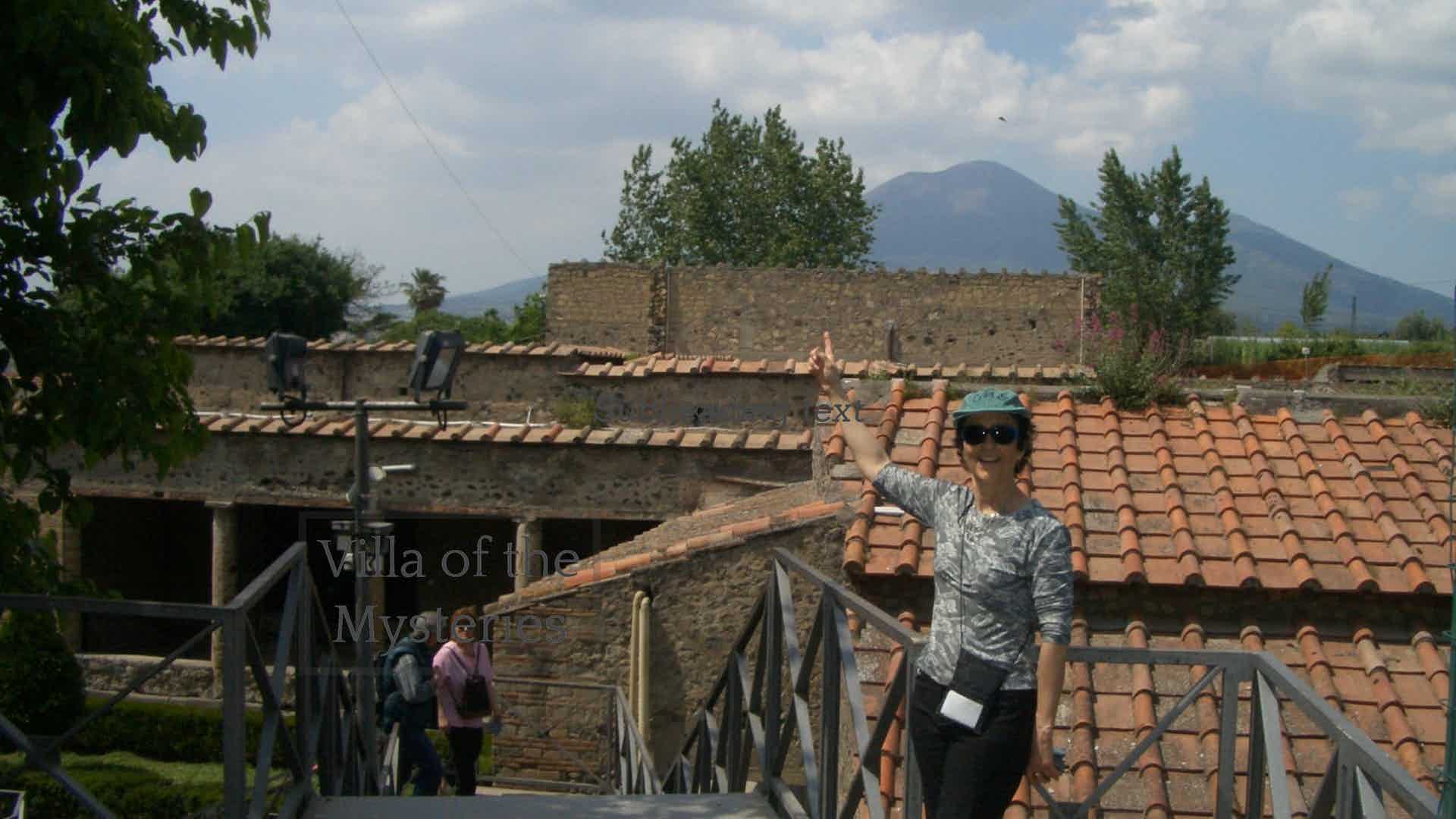
Mary points toward Vesuvius near the Villa of the Mysteries. Photograph by Don Fenton.
Inside the villa we find the frescoes of an initiation rite from perhaps 80 BC. The Dionysiac Frieze wraps around the walls of the dining room, the triclinium. A woman holds a tray of food.
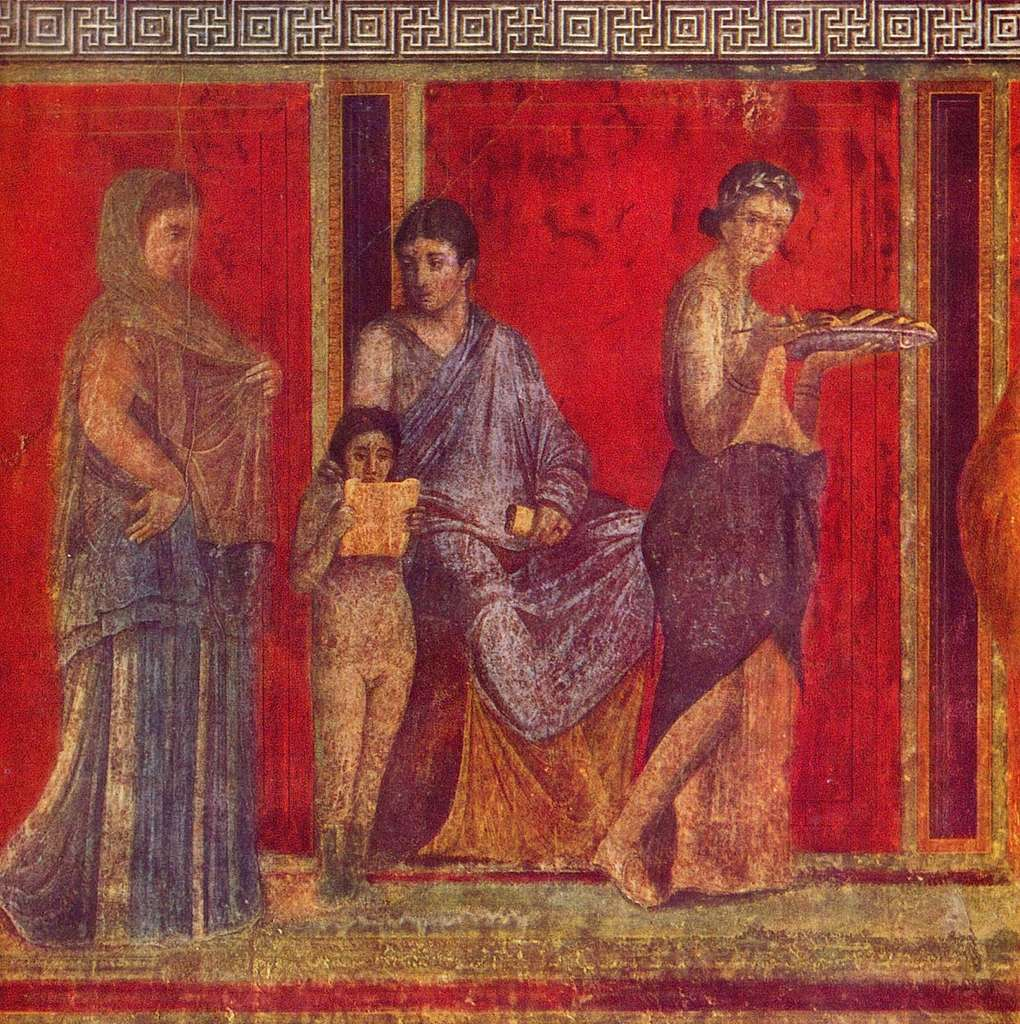
The opening scenes of the Dionysiac Frieze in the Villa of the Mysteries. At right, a woman carries a tray of food.
Mary bought the north wall section of this fresco from the Art Gallery of Ontario as a gift to me. Such a wonderful present. It has graced the wall above our beautiful oak dining room table ever since, quietly watching us as we eat there from time to time, with family and friends.
You might wonder what the woman in the fresco is serving. What tasty morsels are on her tray?
Kate suggested including Roman recipes in this work. Let’s see how that plays out, shall we?
On our walk today we’ll see what Pompeians actually ate throughout this town of 12,000 or so and what’s available at Julia’s villa.
Thermopolia are bustling fast-food shops and social hubs on the streets of the town. I estimate Pompeii has some 75 of these bars and 85 or so cauponae: inns or taverns offering hot meals and wine and maybe even a bed for the night.
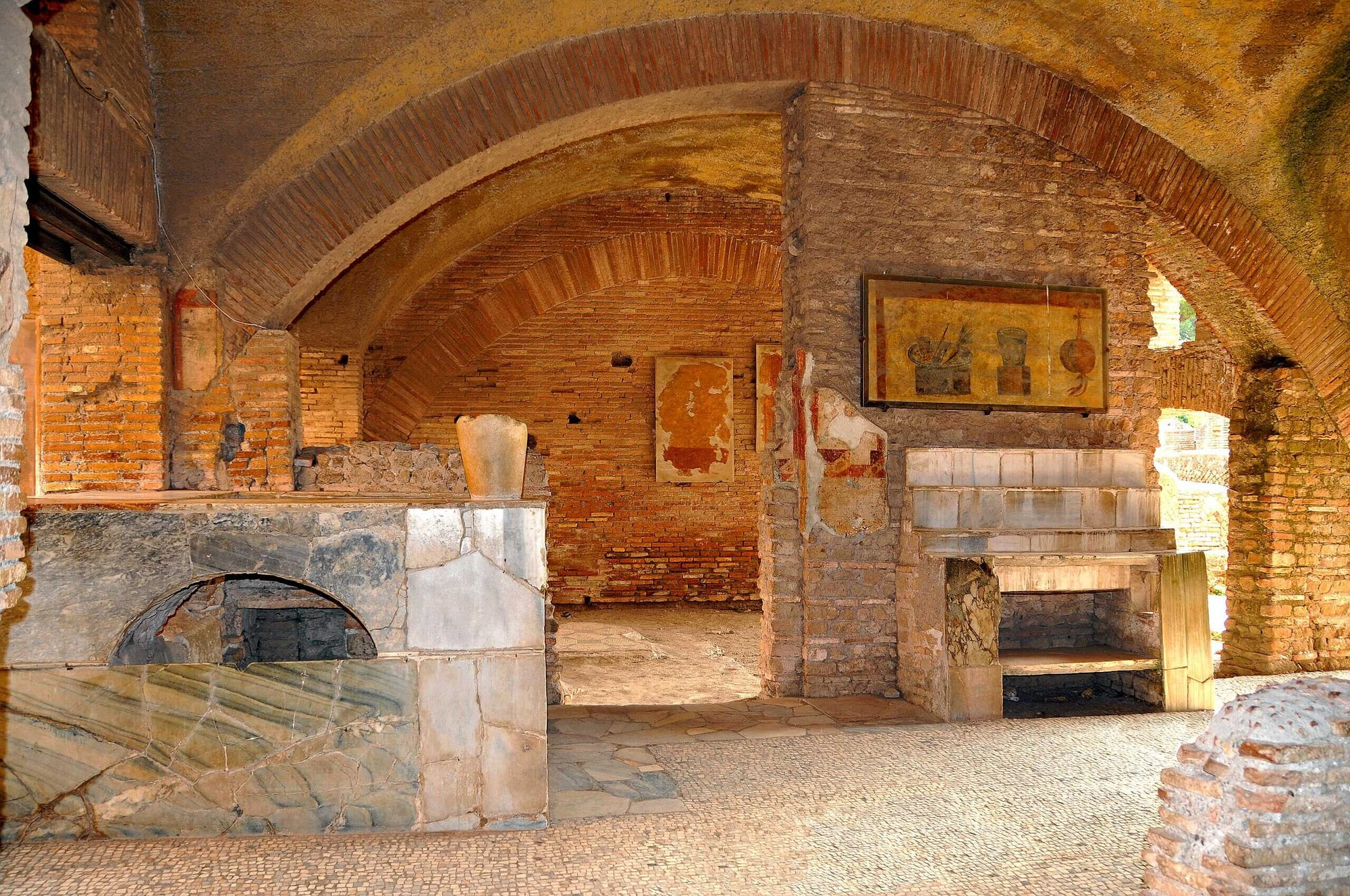
The summer triclinium (dining room) of the Praedia of Julia Felix, with marble couches and small fountains.
Pompeians at all levels of society eat a Mediterranean diet. Pork, lamb and beef, fresh fish, fish sauces, Garum, chickpeas, lentils, cabbage, leeks, onions and garlic, nuts, dates, figs, plums and apples.
Everyone drinks wine and enjoys olive oil, which serves both for cooking and light. Everyone eats bread and ovens seem to be everywhere. Wholemeal bread and many other varieties, maybe as many as fifty or more I have heard. One day historians and archaeologists will confirm this, I’m sure.
Public baths are essential for most residents, many of whom do not have private facilities. Pompeii has five major bath complexes. The very old Stabian Baths built c 125 BC take up an entire insula near the corner of the Via dell’Abbondanza, which leads to Julia’s home and Via Stabiana. The baths received structural damage in February 62 AD and were partly closed for repairs and remodelling. The new Central Baths have just begun construction since the earthquake and will not even be finished before about 79.
While many sites in Pompeii are undergoing extensive reconstruction since the earthquake, the Forum Baths, while still open, are among the smallest in the city. The Sarno Baths also sustained heavy damage in 62.
I count twenty-one bars along the Via dell’Abbondanza from the forum to Julia’s estate
We can stop along the way if you’re feeling a little hungry.
Julia Felix, daughter of Spurius
And now, at last, we arrive.
Her name is painted on a wall: Julia Felix, daughter of Spurius.
The notice offers part of her estate for rent for five years. There are shops with rooms above them, apartments and baths intended for respectable people. It is an advertisement. Practical, direct and unmistakably commercial.
That painted notice is Julia’s footprint in history.
I have never seen her face. No portrait can be identified as Julia Felix. Yet I often place beside her the wonderful Pompeian woman who holds wax tablets in one hand and raises a stylus to her lips. Her husband holds a scroll, but she stands slightly in front of him and looks directly at us.
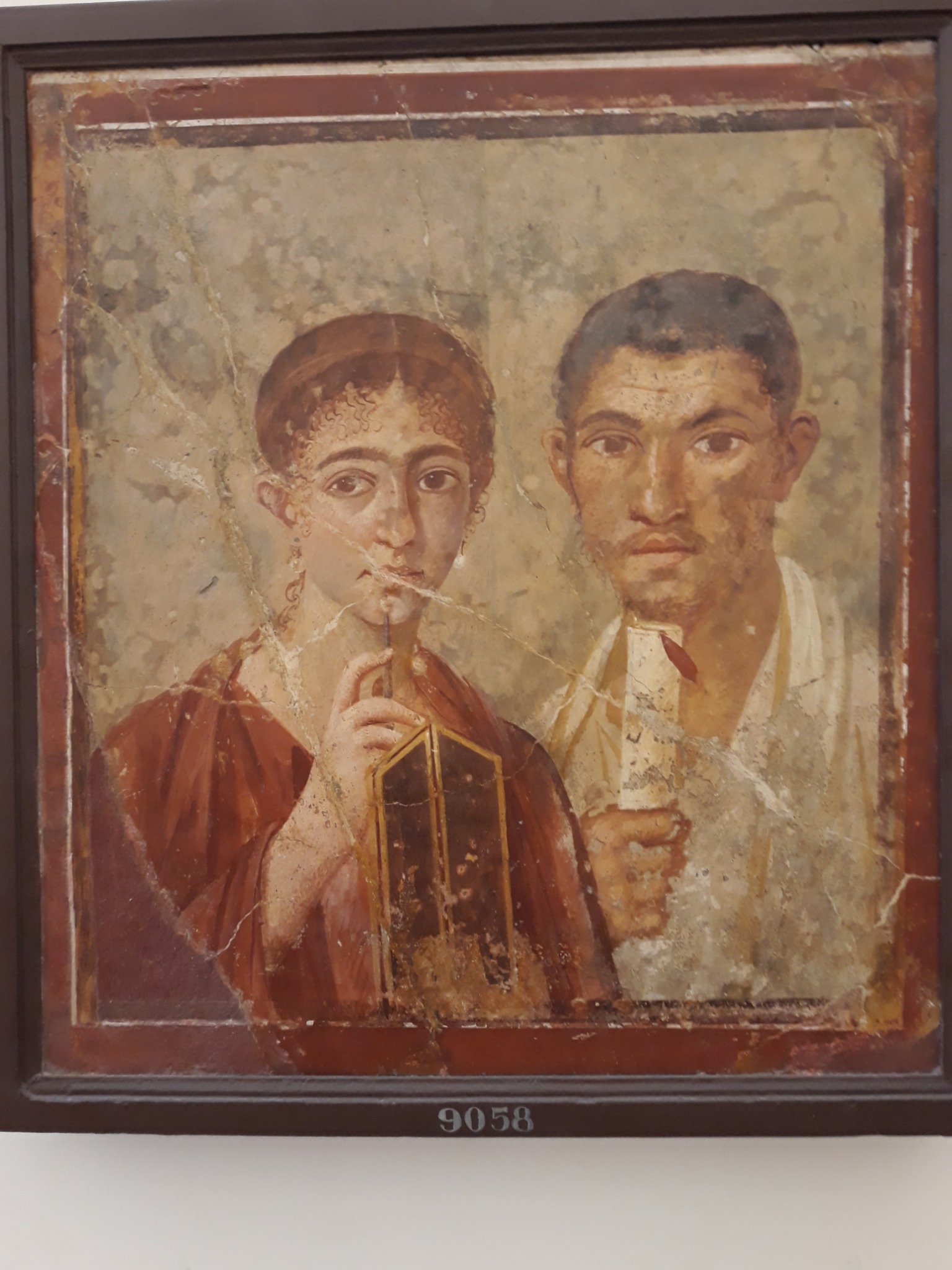
A Pompeian woman with wax tablets and a stylus, beside a man holding a scroll. National Archaeological Museum, Naples. Photograph by Don Fenton.
She is not Julia. I know that. But she reminds me that women in Pompeii could read, calculate, keep accounts and manage property. A still life discovered in Julia’s own estate contains writing materials, money and objects associated with business. So I allow the woman with the stylus to introduce us.
Julia owned an entire city block. She made it work.
Women doing business
Julia was not alone.
We have already passed the enormous building of Eumachia in the Forum. Eumachia was a public priestess and the patron of Pompeii’s fullers, the people who cleaned and finished cloth. Her name appeared prominently on one of the largest buildings in the city.
Another woman, Faustilla, appears in records of small loans. People pledged jewellery and clothing to her as security. These are not stories about empresses looking down from the Palatine. They are records of women dealing with property, money, work and debt.
When I wrote about Julia in 2021, I called her an early feminist. I still understand why I used the word. She has stayed in my mind because she refuses to fit the old picture of the silent, dependent Roman woman.
But I think I would describe her differently now.
Julia does not need a modern label. What she actually did is more interesting. She owned valuable property in her own name, rebuilt it, divided it into different businesses and offered it to the public. She knew what her city needed and found a way to provide it.
That is why we are here.
Then the ground moved
In February of AD 62 - or perhaps 63; the ancient chronology leaves a small uncertainty - the earth beneath Pompeii moved violently.
Seneca was alive when it happened. In his Natural Questions he tells us that much of Pompeii collapsed, Herculaneum was damaged and buildings in Nuceria were shaken. Tacitus also records that a large part of Pompeii was destroyed.
A marble relief found in the house of the banker Lucius Caecilius Iucundus allows us to see how one Pompeian remembered it. The buildings of the Forum lean at impossible angles. Columns sway. The Temple of Jupiter seems to stagger.
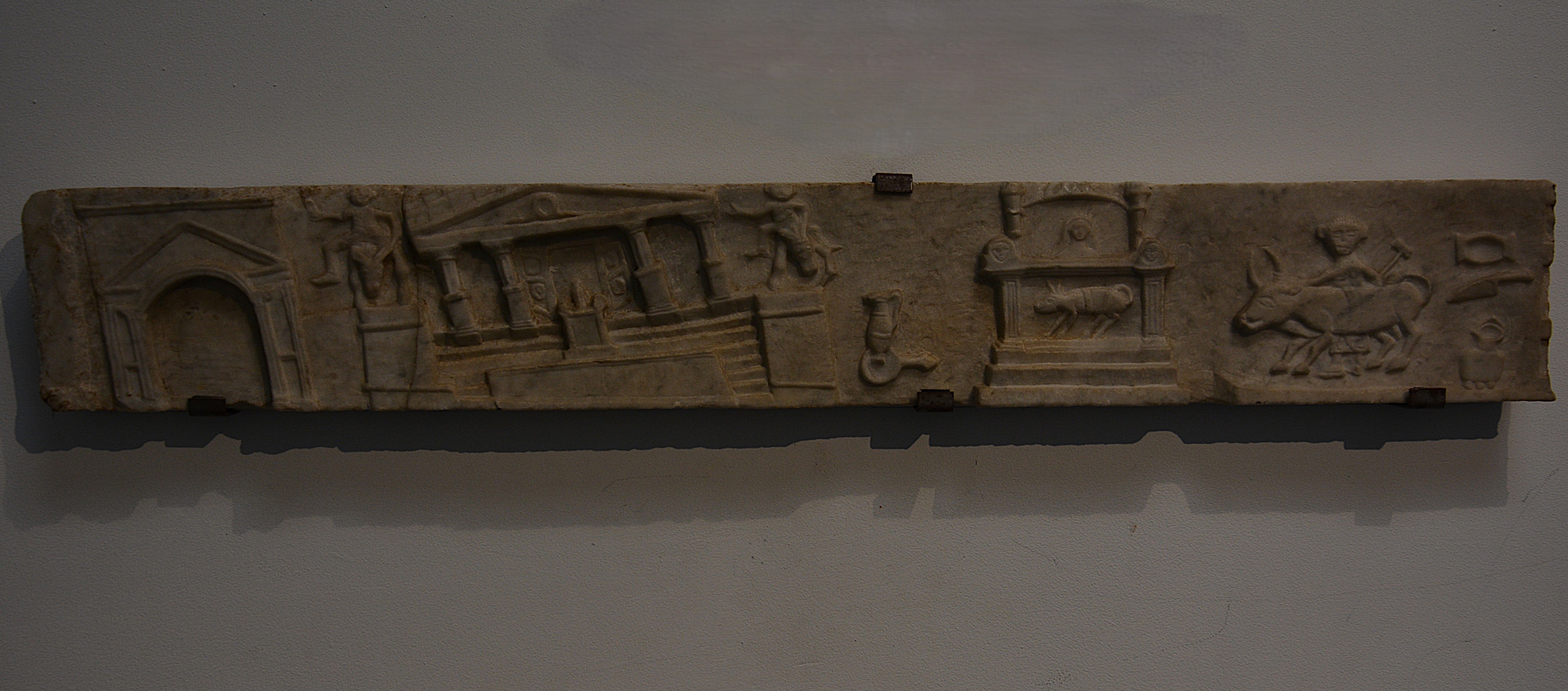
Buildings in the Forum tilt during the earthquake of AD 62 or 63. Marble relief, Antiquarium of Pompeii. Photograph: MentNFG, Wikimedia Commons, CC BY-SA 4.0.
I have thought about that image for years. The artist did not give us a diagram of ruined masonry. He gave us the moment when the solid world ceased to be solid.
Afterward, Pompeii became a city of scaffolding, dust, repair and opportunity. Houses were rebuilt. Walls received new paintings. The Stabian Baths required extensive work. The Central Baths were begun and would still be unfinished when Vesuvius erupted.
Julia looked at this damaged city and saw what people needed: baths, rooms, shops, food and places to rest.
The stones cannot tell me the exact day she made each decision. They tell me enough. The earthquake changed Pompeii. Julia changed her estate.
The Praedia
The Romans called it the Praedia of Julia Felix - the property or estate of Julia Felix.
It occupies an entire insula in Regio II, not far from the amphitheatre and the Large Palaestra. It is not simply a grand house. It is a house, garden, bath establishment, dining place, rental property and commercial centre brought together behind one long street frontage.
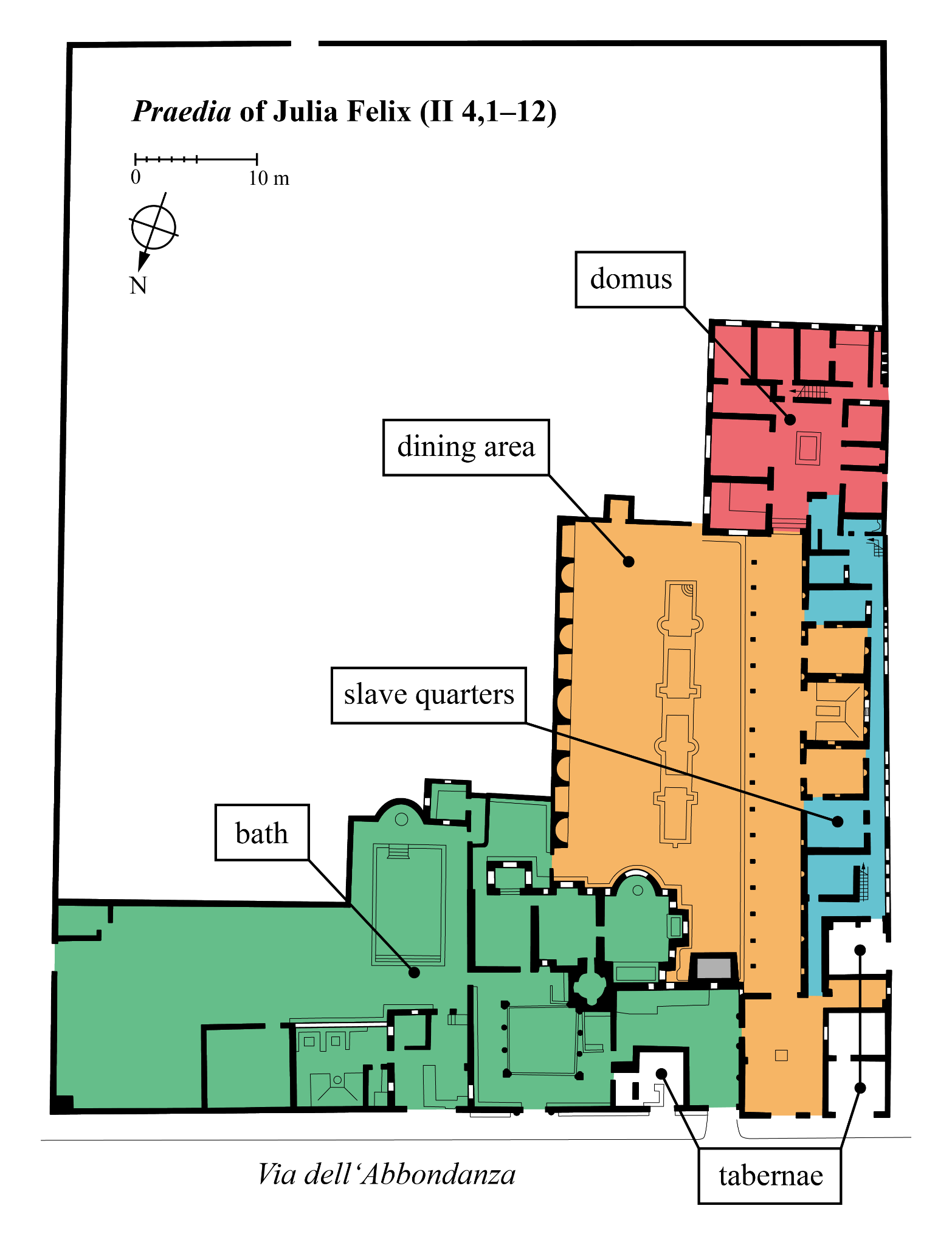
The Praedia of Julia Felix, an estate combining residence, gardens, baths and commercial space.
Let us go inside.
The noise of the Via dell’Abbondanza begins to fall away. We pass from the street into colonnades and gardens. Water moves through a long channel. There are fruit trees, vegetables and flowers. Statues and fountains appear between the columns. Dining couches can be arranged in the shade.
This is not accidental luxury. Julia understands arrival. She knows that a customer who enters from a crowded, dusty street should immediately feel that he or she has come somewhere special.
Her baths offer the familiar Roman progression. First the changing room. Then the cold room, the warm room and the hot room: frigidarium, tepidarium and calidarium. There is also a laconicum for sweating. Heat rises from the floors and through the walls. Water, fire, labour and careful engineering make pleasure possible.
The decoration tells us something too. Marble, painted walls, garden architecture and water displays do not belong to a makeshift lodging house. Julia is competing for customers.
Perhaps some come only to bathe. Others rent rooms. Some meet friends, conduct business or stay to eat. Along the street front, shops and food-and-drink counters catch the people who never enter the quieter world of the garden.
Julia has more than one kind of customer in mind.
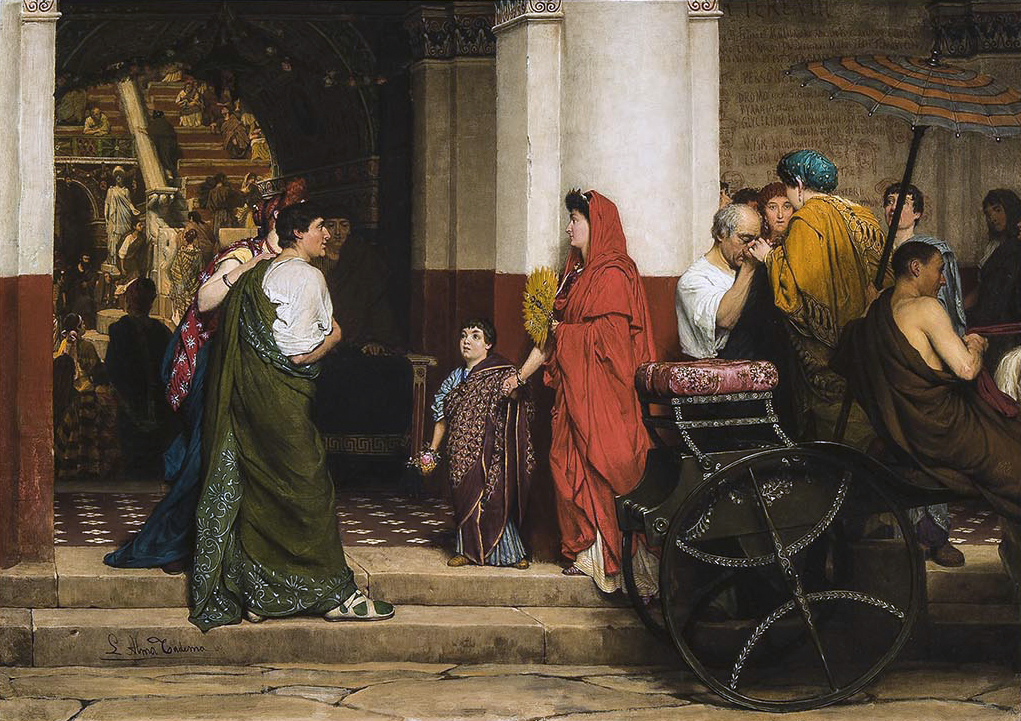
Entrance to the theatre, by Lawrence Alma-Tadema.
A day with Julia
Imagine arriving in the morning.
Bread is already baking somewhere nearby. Pompeii is full of mills and ovens, and I have stood in one of its bakeries beside the great stone mills. Donkeys or enslaved workers once pushed the wooden beams around them, crushing grain between two heavy pieces of volcanic stone.
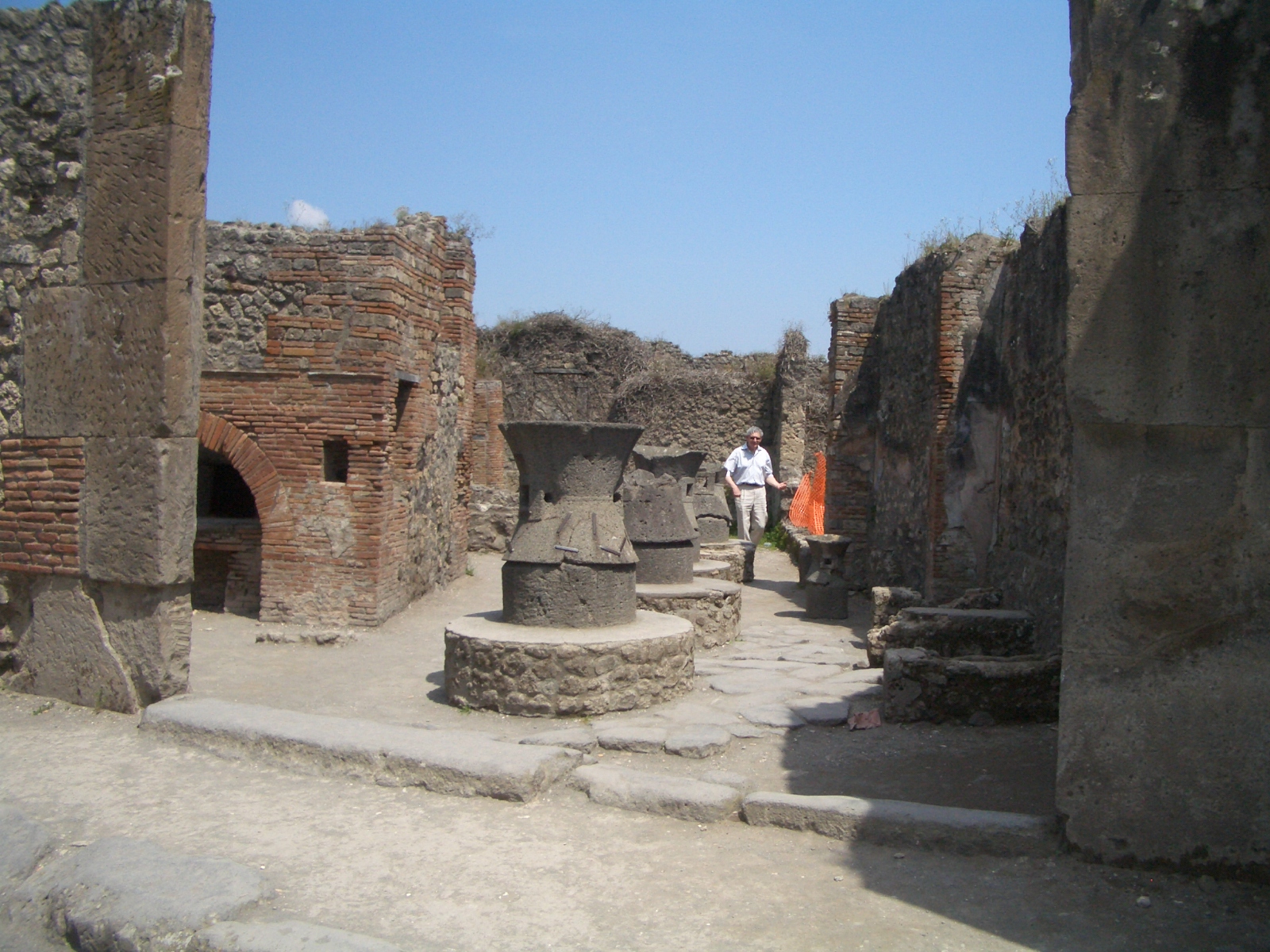
Don beside the ancient millstones in a Pompeian bakery. Photograph from the Don and Mary Fenton collection.
They have come for the baths. They have walked through warm rooms, scraped oil and perspiration from their skin and cooled themselves in water. Now they are hungry.
Kate suggested that I include Roman recipes in this story. It was exactly the right suggestion. Ruins tell us where people ate. Recipes bring the dishes back to the table.
The Classical Cookbook by Andrew Dalby and Sally Grainger, and Julia della Croce’s Roma, have helped me imagine what could be served here without pretending that we possess Julia’s own menu.
Let us begin with olives, eggs, cheese, bread and perhaps mussels. We can drink mulsum, wine sweetened with honey. Then fish with herbs and garum, chicken or pork, lentils or vegetables dressed with olive oil and vinegar. Afterward there may be dates, nuts, honey cakes, libum - a small cheese cake - or pear patina.
Pear patina appeals to me. Pears are cooked and combined with honey, cumin, pepper, raisin wine and egg. The mixture sounds strange to a modern ear. That is a good reason to taste it.
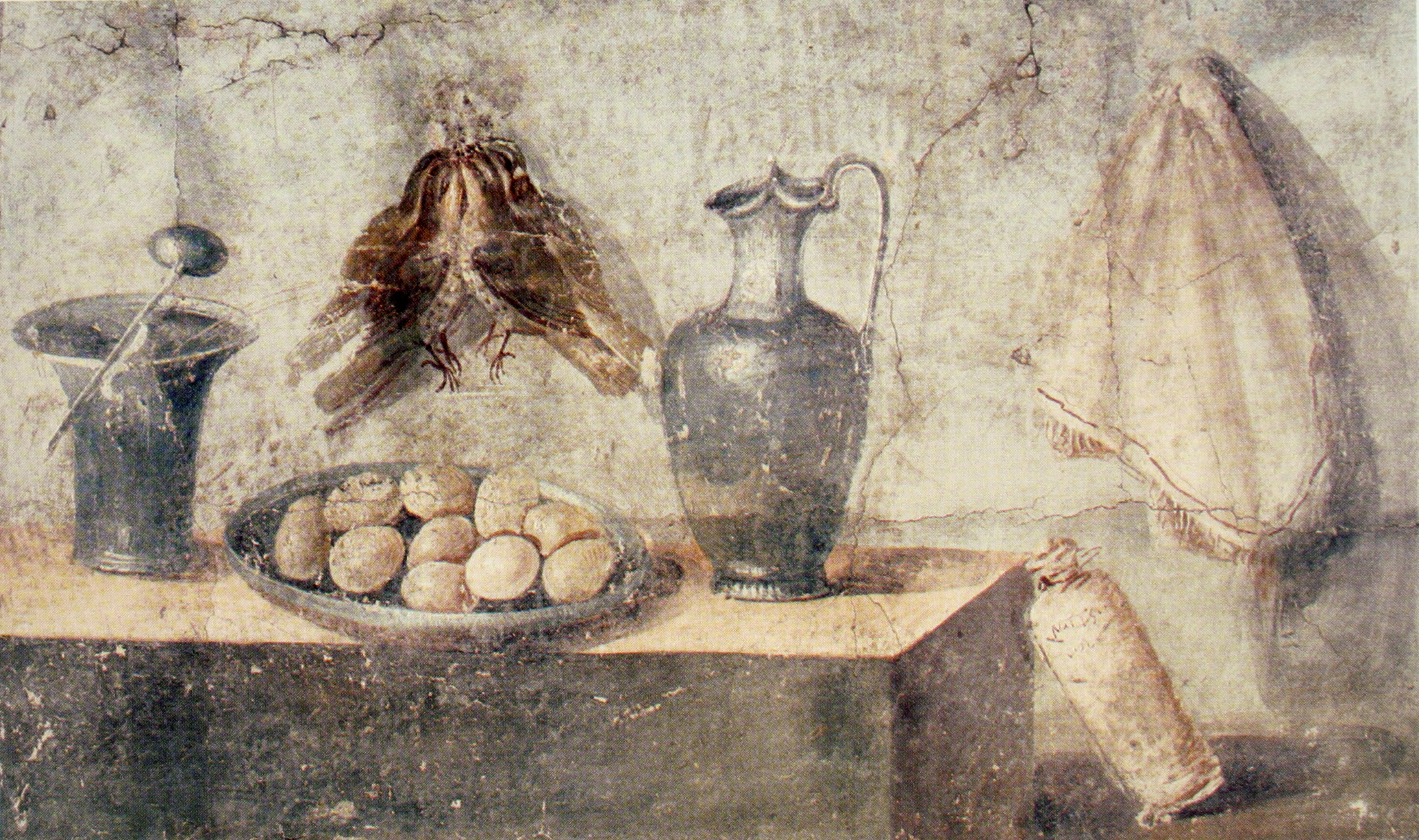
Eggs, birds, vessels and provisions from the Villa of Julia Felix.
The frescoes make that desire almost irresistible. Fruit, birds, eggs, fish, bread and shining vessels remain fresh on walls nearly two thousand years old. At Oplontis, not far away, a basket of figs lies beneath a mysterious transparent covering. It looks uncannily like plastic wrap.
Of course it is not. But the painter understood transparency, reflection and the softness of ripe fruit. Two thousand years disappear.
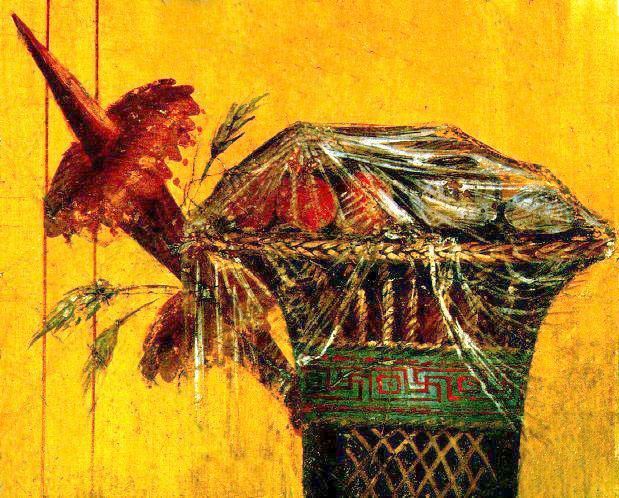
A basket of figs at the Villa of Poppaea, Oplontis. The painter even suggests a transparent covering.
Out on the street
Not everyone comes for a leisurely meal beside Julia’s garden.
Outside, the Via dell’Abbondanza is alive. We have already counted twenty-one bars between the Forum and Julia’s estate. Their counters contain large pottery jars. Customers stand, sit, gossip, argue, drink and eat.
What do they order?
Seneca once lived above a bathhouse and complained about the noise below him. Among the splashing, shouting and singing, he heard sellers crying out sausages, cakes and other foods. His irritation gives us the sound of the Roman street.
Lucanian sausage is a tempting possibility for Julia’s counters. The recipe associated with Apicius combines minced pork, pepper, herbs and fish sauce before the sausages are cooked or smoked. Put one beside a piece of bread, add olives and watered wine, and an ordinary Pompeian can eat quickly and continue along the street.
I can imagine the rush after the games.
The amphitheatre is only a short distance away. Thousands of people pour out beneath the afternoon sun, talking about the fighters, looking for friends and searching for food and drink. Julia’s position is excellent.
A fresco from the House of Actius Anicetus shows what could happen when such a crowd turned violent. In AD 59, Pompeians and visitors from nearby Nuceria exchanged insults at the amphitheatre. Insults became stones, and stones became weapons.
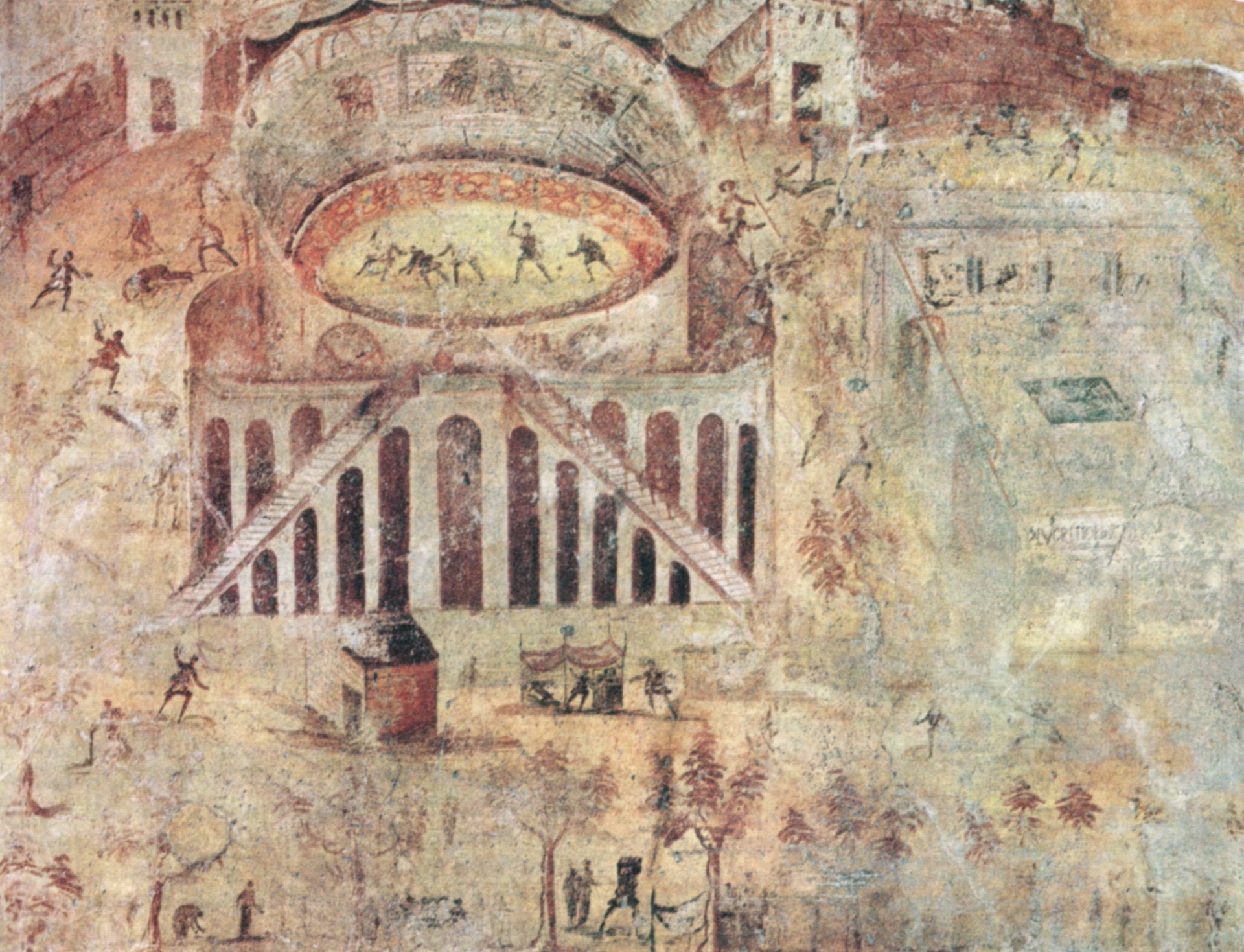
The riot between Pompeians and Nucerians at the amphitheatre in AD 59. National Archaeological Museum, Naples.
I have always come back to this fresco. It shows the amphitheatre with its awnings, the Large Palaestra beside it, stalls outside and fighting spreading across the open ground. Tacitus tells the same story in words. People were wounded and killed, and Pompeii was punished with a ten-year ban on such gatherings.
This was Julia’s neighbourhood.
The ban did not last the full ten years. The games returned. So did the crowds. And Julia’s shops, baths and rooms were waiting.
The Pompeian pizza
One recent discovery gives our walk an irresistible connection with Naples today.
In 2023, archaeologists working in Regio IX uncovered a still-life fresco in a house connected with a bakery. On a silver tray lies a round flat bread surrounded by fruit and accompanied by a cup of wine.
It looks like pizza.
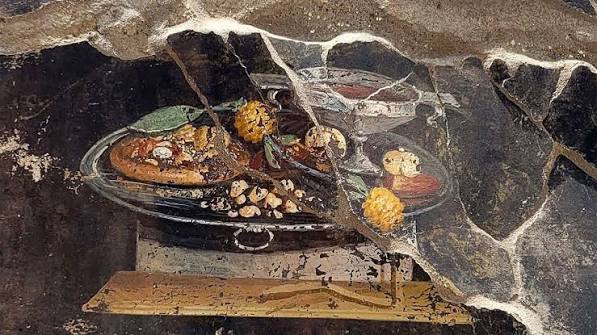
The pizza-like still life discovered in Regio IX in 2023: flat bread, fruit and wine arranged as gifts of hospitality.
It is not the pizza we know. Tomatoes have not yet arrived from the Americas, and there is no mozzarella topping. The image belongs to the ancient tradition of xenia, gifts of hospitality: bread and other foods offered to a guest.
Still, I think a modern Neapolitan is entitled to smile.
The fresco was found elsewhere in Pompeii, not in Julia’s estate. But it shows food as a Pompeian wanted it to be seen: abundant, attractive and ready to share. That belongs naturally at Julia’s table.
The Eruption of AD 79
Seventeen years or so after the earthquake, sometime in AD 79, the mountain moved again.
This time it did not stop.
Pliny the Younger was across the bay at Misenum. He watched an extraordinary cloud rise above Vesuvius. It looked to him like a pine tree, climbing high into the sky before spreading into branches.
His uncle, Pliny the Elder, commanded the Roman fleet. He first prepared to sail closer from scientific curiosity. Then messages arrived from people trapped along the coast, and inquiry became rescue. He crossed the bay and died at Stabiae in the falling debris.
At Pompeii, pumice fell for hour after hour. Roofs collapsed under its weight. People fled with children, money, jewellery, lamps, keys and whatever else they could carry. Some sheltered indoors and waited. Then the surges came.
The streets, bars, baths, gardens and dining rooms disappear.
So does Julia.
I do not know whether she was still living in Pompeii that August. I do not know whether she escaped. I will not invent an ending for her simply because I want one.
Instead, I return to what she left us: her name painted on a wall and her extraordinary estate.
Martial later remembered Vesuvius when its slopes had been green with vines, a place loved by Bacchus and Venus. Statius imagined the land becoming green again until future generations could scarcely believe that cities and people lay buried beneath it.
The fields returned long before the city did.
What remains
Today the Praedia of Julia Felix is open to the sky.
We can walk along the Via dell’Abbondanza and enter rooms built for people who had no idea they were living in a place that would become archaeology. We can see the baths, the columns, the garden and the long water channel. We can stand where someone once asked for a room, ordered wine, paid for a bath or sat down to eat.
History has been kind to us in one sense and cruel in another. It preserved Julia’s property by destroying her city.
At the beginning of our walk I asked why I am so obsessed with the ancient world.
Perhaps this is part of the answer.
The people of Pompeii did not think of themselves as ancient. They worried about repairs, rent, customers, meals, family and tomorrow. Julia looked at a damaged property and imagined what it could become. Mary and I stand beneath the same mountain. Kate asks what Julia served, and suddenly we are all at the table together.
The distance between us is immense.
And then, for a moment, it is gone.
Two thousand years later, we still know her name.
Julia Felix, daughter of Spurius.
Come. Let us walk through her door.
